The “line” in Soviet life
A Gentleman in MoscowThe “line” in Soviet life begins as a familiar queue and expands into an image of a society organized by waiting, sequence, and administrative order. In a crowded Moscow square, a queue of 150 citizens waiting to see Vladimir Lenin’s remains becomes the point of departure for the idea that the country’s many separate lines are really one continuous line, extending across Russia and through time. The image holds both sides of that order: it can teach patience and civility, yet it also belongs to a world in which people, resources, and histories are arranged and counted from above.
From Queue to Social Form
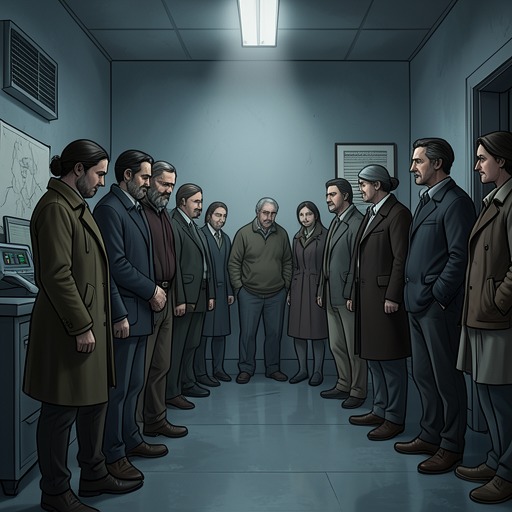
A queue outside Vladimir Lenin’s tomb gathers citizens from different regions and backgrounds into a visible sequence: eight Uzbeks in silk coats, four girls from the east in embroidered caps, then ten Georgian muzhiks, with further groups waiting behind them. The narrator’s solitary observer recognizes the orderly behavior of these strangers as a hard-won social habit. The scene makes waiting more than an inconvenience; it is a public practice shared across the country.
The reflection then enlarges the picture. There are queues at tram stops and grocers, and before agencies handling labor, education, and housing, but the observer imagines them as branches of one all-encompassing line. In that account, Vladimir Lenin established the line by decree in 1917 and took the first place in it, while everyone else joined behind him. The line grows until it seems to share the attributes of life itself: friendships form, romances kindle, patience develops, civility is practiced, and even wisdom can be attained. The metaphor turns a routine constraint into a collective social environment, where people encounter one another not outside the system but while waiting within it.
The eight-hour wait to buy a loaf of bread sharpens the contrast between necessity and choice. Against that familiar duration, an hour or two spent waiting to view a dead hero seems comparatively small. The thought is wry, but it also makes the line’s reach plain: waiting structures both access to everyday necessities and participation in public ritual.
Plans, Quotas, and the Cost of Order
The line’s logic of sequence and allocation resonates with the state’s effort to coordinate economic life. The First Five-Year Plan, launched on January 3, 1928, set out to transform Russia from an agrarian society into an industrial power. Tens of thousands of urban workers built power stations, steel mills, and heavy-machinery plants; the grain-producing regions, in turn, were expected to supply the cities with more bread through increased agricultural production.
That demand was imposed on a countryside already being remade. A million kulaks were to be exiled, although they were also the regions’ most capable farmers. Peasants regarded new agricultural methods with suspicion, tractors intended to introduce mechanized farming were scarce, and bad weather compounded the fall in output. Yet the need to feed the cities led not to relief from the target but to higher quotas and requisitions enforced at gunpoint. In 1932, these pressures contributed to widespread hardship in the agricultural provinces and starvation deaths among millions of peasants in Ukraine. The narrative places the promised order of planning beside its concrete failures: production could be specified and demanded, but machinery, weather, and local knowledge did not obey the plan.
The narrator’s account of history likewise resists reducing lived experience to a single decisive point. Historians identify turning dates from the safety of hindsight: the launch of the First Five-Year Plan, Bukharin’s removal from the Politburo on November 17, 1929, or the drafting of Article 58 of the Soviet Criminal Code on February 25, 1927. Against such markers, the line suggests duration: history is also the drawn-out succession of people waiting, working, being moved, and living with the consequences of decisions.
Procedures and Files
The same ordering impulse appears in the Boyarsky Restaurant, where staff are assembled to learn a new system for taking, placing, and billing orders. A waiter is to write each order on a pad and carry it to a bookkeeper, who records it in a ledger and issues a cooking slip. The kitchen logs that slip before cooking begins; once the food is ready, it sends a confirmation slip to the bookkeeper, who stamps a receipt authorizing the waiter to retrieve the dish. Only then can the waiter mark the order as finally delivered to the table. An ordinary meal is divided into a chain of recorded stages, each dependent on a written confirmation of the one before it.
The contrast is not between writing and a rejection of writing. The Count admires literature and the power of written words; his objection to the new regimen is that it changes the encounter between waiter and customer. At the Piazza, diners might expect a waiter to lean over the table and write. At the Boyarsky, customers had been accustomed to a server who looked them in the eye, answered questions, made recommendations, and remembered preferences without taking his hands from behind his back. The new procedure makes the transaction more traceable while displacing the attentive service that had defined the restaurant.
A more coercive form of record-making lies in the Bishop’s filing cabinets. The first three contain reports on hotel operations, including revenue, occupancy, staffing, maintenance, inventories, and discrepancies. The remaining cabinets hold files on guests and staff, including Arkady, Vasily, Andrey, Emile, and Marina. These records list instances of tardiness, impertinence, disaffection, drunkenness, sloth, and desire. The Count recognizes that the entries need not be false to be distorting: a file can accurately preserve someone’s failings while omitting the virtues that would make the portrait fuller. In this version of the line, people are not merely made to wait; they are sorted into records that determine what can be seen about them.
Significance
Across the queue, the production plan, the restaurant workflow, and the personnel files, the image connects distinct forms of ordering without making them identical. A queue can create a shared public rhythm and a space for patience; a quota backed by force or a file designed to catalogue human weaknesses exercises power over those placed within the system. The novel’s recurring concern is therefore not order in the abstract, but the difference between an order people inhabit together and a scheme that treats their lives as entries to be managed.
The line also counters the appeal of naming one turning point as the whole explanation of history. Dates and administrative records can make events legible, just as slips and ledgers make a meal trackable. But the line’s length insists on what such summaries leave out: duration, personal encounters, material shortages, and the consequences that accumulate while people wait. It is at once a social habit, a governing image, and a measure of the distance between an orderly system on paper and the lives compelled to move through it.